Greenhouse Gas Management

Supporting the SDGs Goals
Stakeholders Directly Impacted


Goals and Performance Highlights



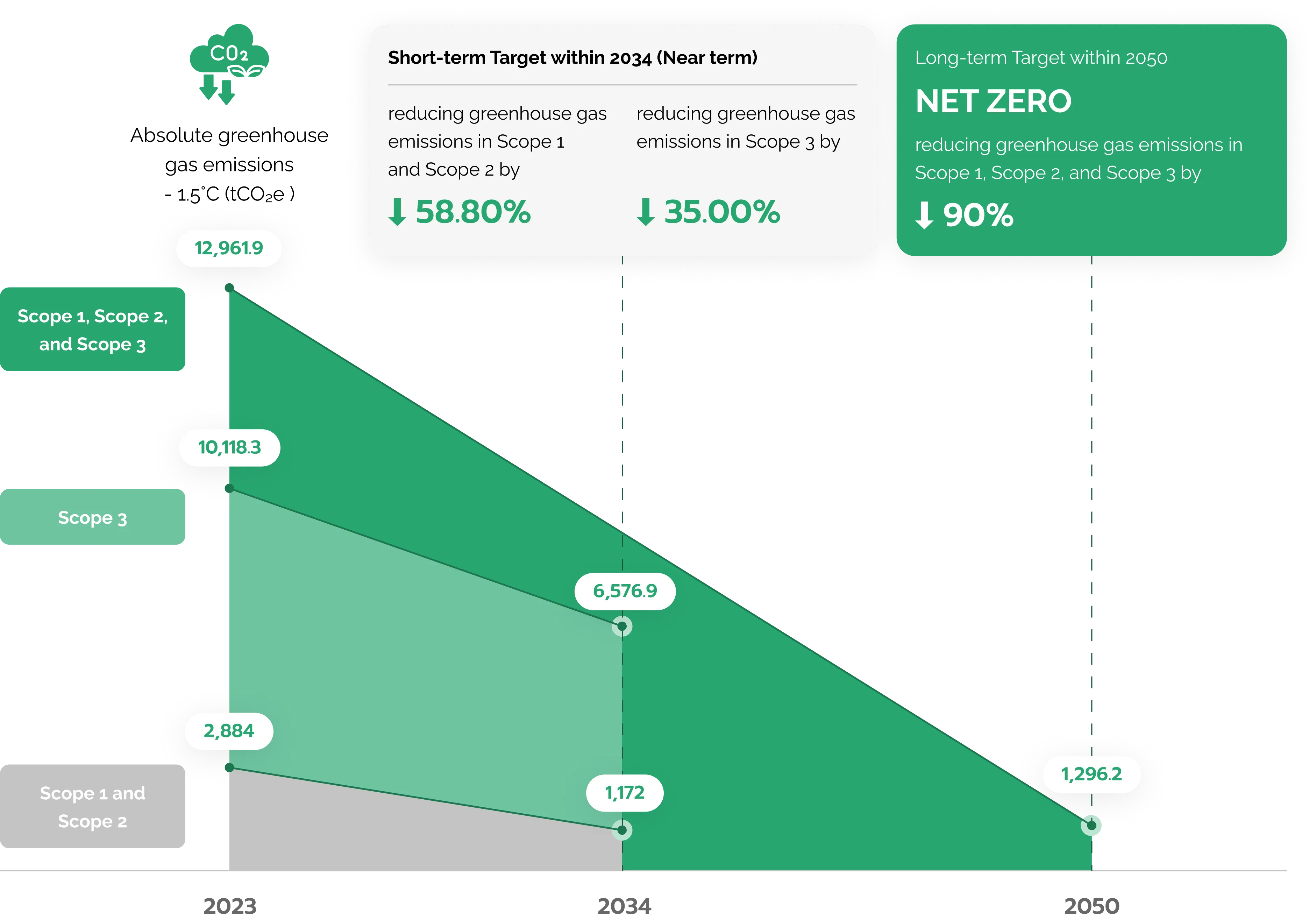


*Remark : Expanding the scope of emissions calculations to include the entire Group of companies in 2025.*

Commitment, Challenge and Opportunity
The group recognizes the impact of climate change, as it operates industrial factories that emit greenhouse gases, which are a key cause of climate change. The company strives to help mitigate global warming by effectively managing greenhouse gas emissions from internal activities to reduce emissions in factories. This starts with creating the organization’s carbon footprint data (Carbon Footprint for Organization: CFO), a method to assess greenhouse gas emissions from the organization’s operations and calculate them as carbon dioxide equivalent, which leads to the development of management approaches to reduce greenhouse gas emissions effectively.
Management and Operational Approach
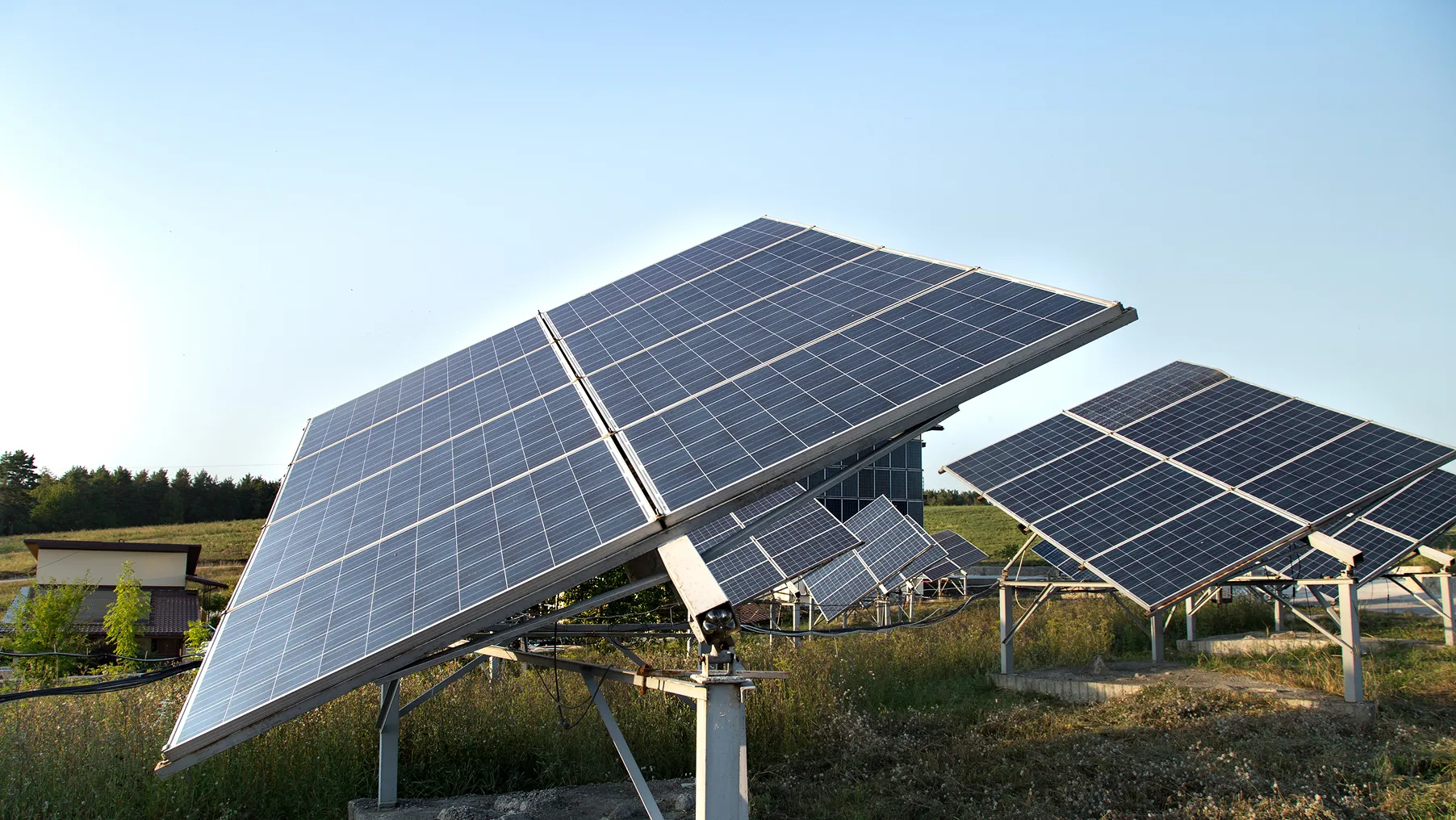
In managing greenhouse gases, the group has set a policy on social and environmental responsibility regarding greenhouse gas emissions (carbon footprint). The company has also formulated strategies for managing greenhouse gases by using renewable energy, along with other important methods. Measures to Reduce Greenhouse Gas Emissions are as follows
BLC has a plan to reduce greenhouse gas emissions in each category, divided into three main areas:



| Details | Unit | Scope | 2023 | 2024 | 2025 |
|---|---|---|---|---|---|

Group of Companies
|
|||||
| tCO2e | Scope 1 & 2 | 2,844.0* | - | 2,967.0** | |
| tCO2e | Scope 1 & 2 & 3 | 12,961.9* | - | 6,920.0** | |

BLC (Ratchaburi Plant)
|
|||||
| tCO2e | Scope 1 & 2 | 2,467.0** | 2,654.0*** | - | |
| tCO2e | Scope 1 & 2 | 5,445.0** | 5,963.0*** | - | |

Production Weight
|
Ton | - | 939.87 | 1,159.90 | 1,209.54 |
Note:
* No verification
** Verified by TÜV NORD (Thailand) Ltd. and certified by the Greenhouse Gas Management Organization (Public Organization)

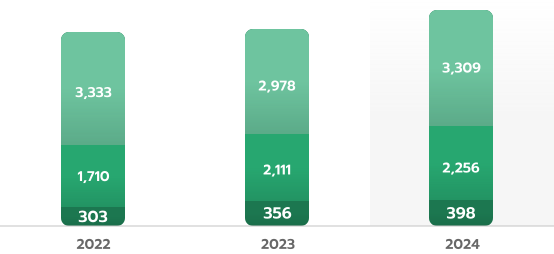
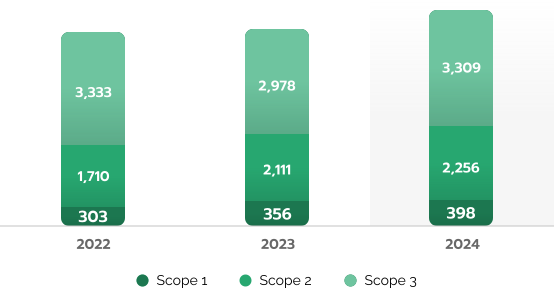
According to the greenhouse gas emissions assessment for the year 2024, BLC’s total emissions were 5,963 tons of CO2 equivalent, which represents a 9.17% increase from 2023. However, the emissions per product weight in 2024, compared to the 2023 emissions per product weight, showed a 12.83% reduction for Scope 1 and 2 emissions, and an 11.26% reduction for Scope 1, 2, and 3 emissions, meeting the target of a 5% reduction in greenhouse gas emissions per product weight compared to 2023
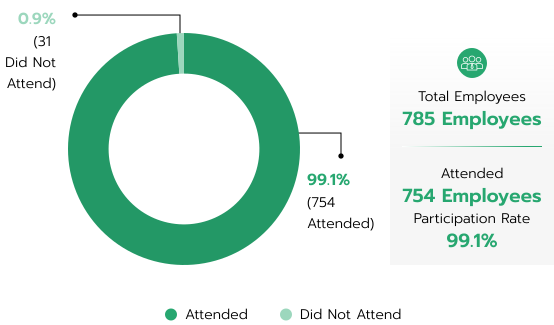
The Company conducted a training program to enhance employees’ awareness and understanding of greenhouse gas management. A total of 754 employees participated, representing 99.10% of BLC employees. Following the training, participants completed a knowledge assessment, and more than 90% of the participants answered all questions correctly.
Based on the assessment results, it can be inferred that employees have a strong understanding of the organization’s greenhouse gas emissions reduction efforts. The Environmental Management System Committee will continue to develop and disseminate information on the Company’s greenhouse gas emissions reduction initiatives to further strengthen environmental awareness among employees.